
Spanish Conjugation Chart
Spanish verbs change their endings for every person and tense, and a good chart makes the patterns obvious. This printable pack sets out the regular -ar, -er and -ir endings in the present, preterite, imperfect, future, conditional and present subjunctive, the ten irregular verbs learners meet first, and blank charts to practise until the endings are automatic.
- Instant download
- Editable Word & Excel
- Print-ready PDF
- 7-day refund
11 files · PDF, DOCX, XLSX
Spanish Conjugation Chart Pack
Printable Spanish verb charts: regular -ar/-er/-ir in six tenses, ten irregular verbs, stem-changing verbs, blank practice charts with answers and an Excel verb drill.
- Present (PDF)
- Preterite (PDF)
- Imperfect (PDF)
- + 8 more
$5.00 USD, one-time 11 files · about $0.45 each
- Instant download
- 7-day refund
- Secure checkout by Stripe
✓ Classroom use included
7-day money-back guarantee. Full refund within 7 days of purchase, even after you download.
Free sample: Spanish Regular Present (PDF, 53 KB)
License: personal and classroom use. Teachers may print and photocopy these files for the students in their own classes, and share them in a password-protected class space (e.g. Google Classroom). Please do not resell, redistribute, or post the files on public websites. One purchase covers one teacher.
Spanish Conjugation Chart Pack
Printable Spanish verb charts: regular -ar/-er/-ir in six tenses, ten irregular verbs, stem-changing verbs, blank practice charts with answers and an Excel verb drill.
- Present (PDF)
- Preterite (PDF)
- Imperfect (PDF)
- Future (PDF)
- Conditional (PDF)
- Present subjunctive (PDF)
- Irregular verbs (PDF)
- Stem-changing verbs (PDF)
- Practice chart (PDF, DOCX)
- Preterite practice (PDF, DOCX)
- Verb drill (XLSX)
Formats: PDF, DOCX, XLSX. Instant download after payment (link valid 72 hours, up to 5 downloads). AI-assisted: the templates were drafted with AI help and reviewed and laid out before publishing.
$5.00 USD, one-time 11 files · about $0.45 each
- Instant download
- 7-day refund
- Secure checkout by Stripe
7-day money-back guarantee. Full refund within 7 days of purchase, even after you download.
Free sample: Spanish Regular Present (PDF, 53 KB)
Full refund within 7 days — see the refund policy and license.
Free printables
Single sheets you can print right now, no sign-up. The full pack adds every sheet in one download plus the editable files.
 Printable Spanish Present Tense Chart1 page · free PDF
 Printable Preterite Conjugation Chart1 page · free PDF
 Printable Spanish Imperfect Verb Chart1 page · free PDF
 Printable Spanish Future Conjugation Chart1 page · free PDF
 Printable Spanish Conditional Conjugation Chart1 page · free PDF
 Printable Spanish Present Subjunctive Chart1 page · free PDF
 Printable Spanish Irregular Verbs Chart1 page · free PDF
 Printable Stem-Changing Verbs Chart1 page · free PDF
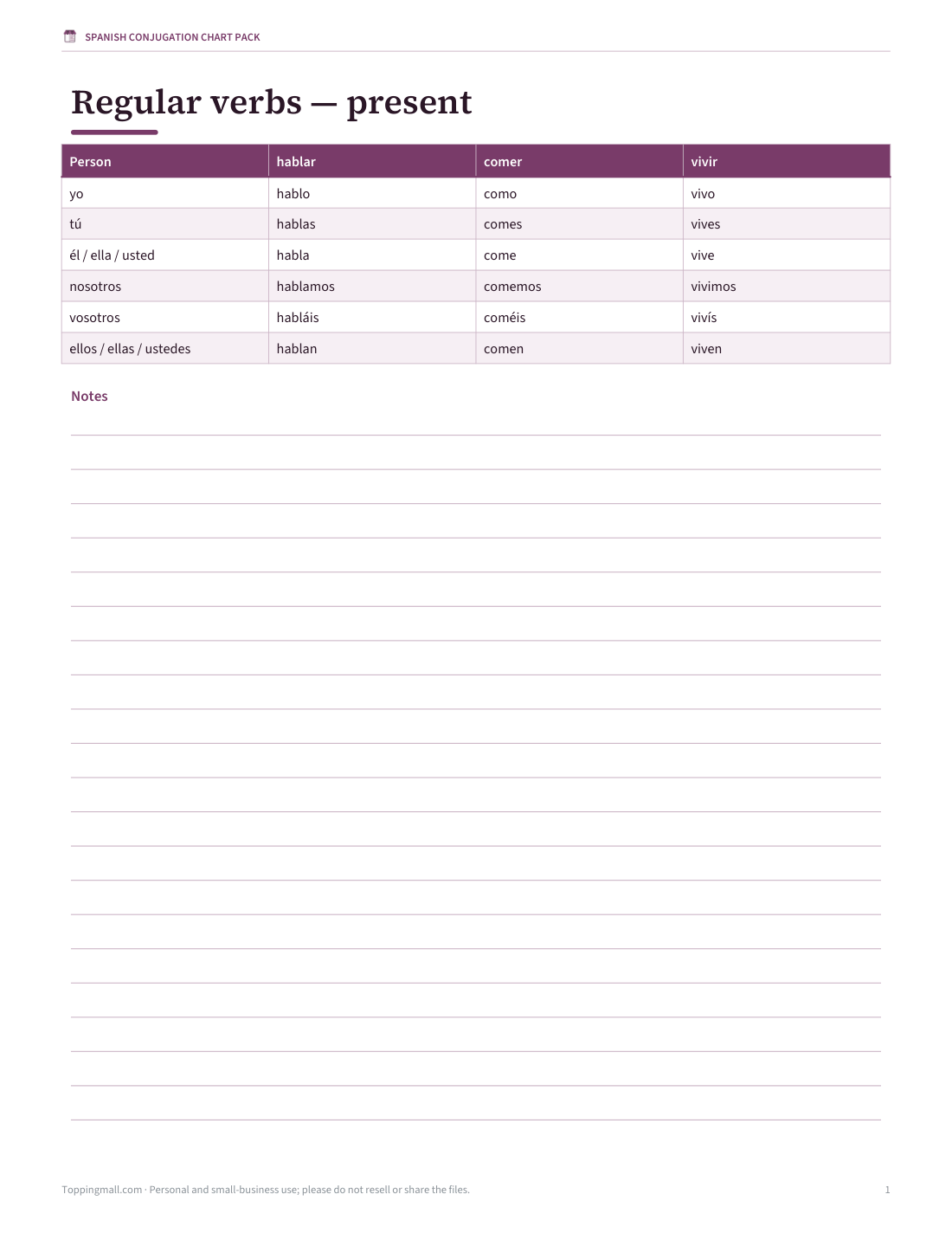
Regular verbs in the present tense
| Person | hablar (to speak) | comer (to eat) | vivir (to live) |
|---|---|---|---|
| yo | hablo | como | vivo |
| tú | hablas | comes | vives |
| él / ella / usted | habla | come | vive |
| nosotros | hablamos | comemos | vivimos |
| vosotros | habláis | coméis | vivís |
| ellos / ellas / ustedes | hablan | comen | viven |
Drop -ar, -er or -ir to find the stem, then add the ending. -er and -ir verbs share every present ending except nosotros (-emos / -imos) and vosotros (-éis / -ís).
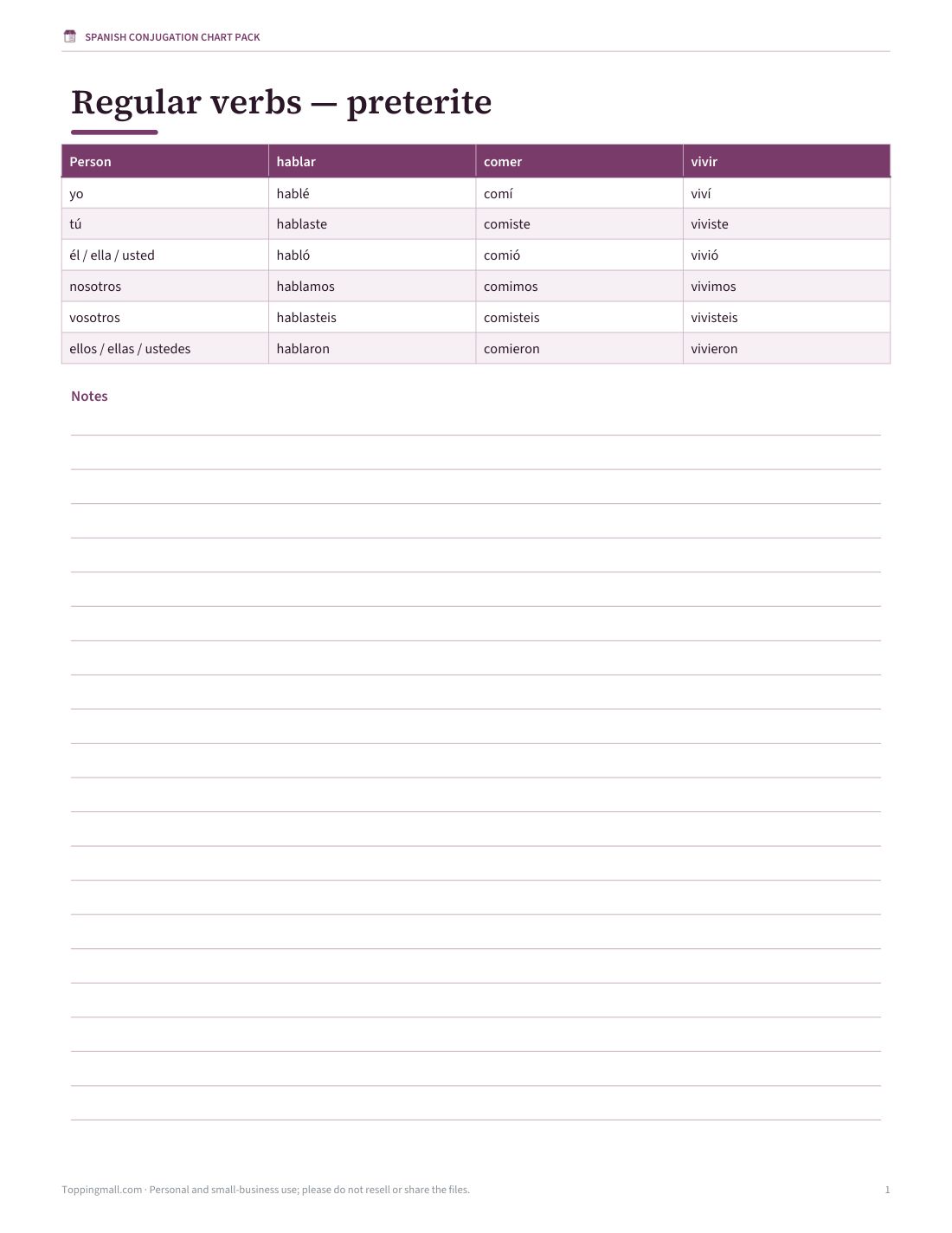
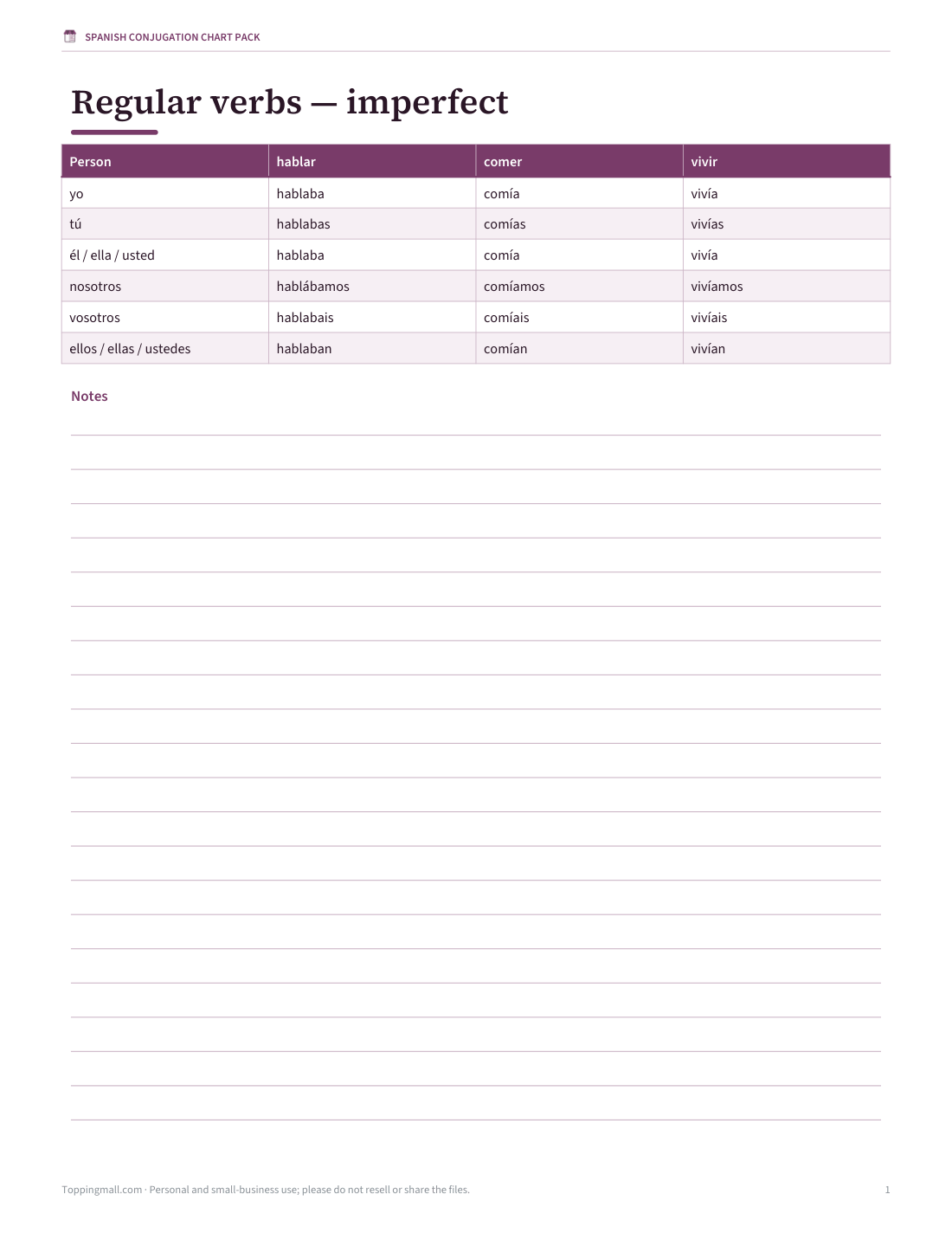
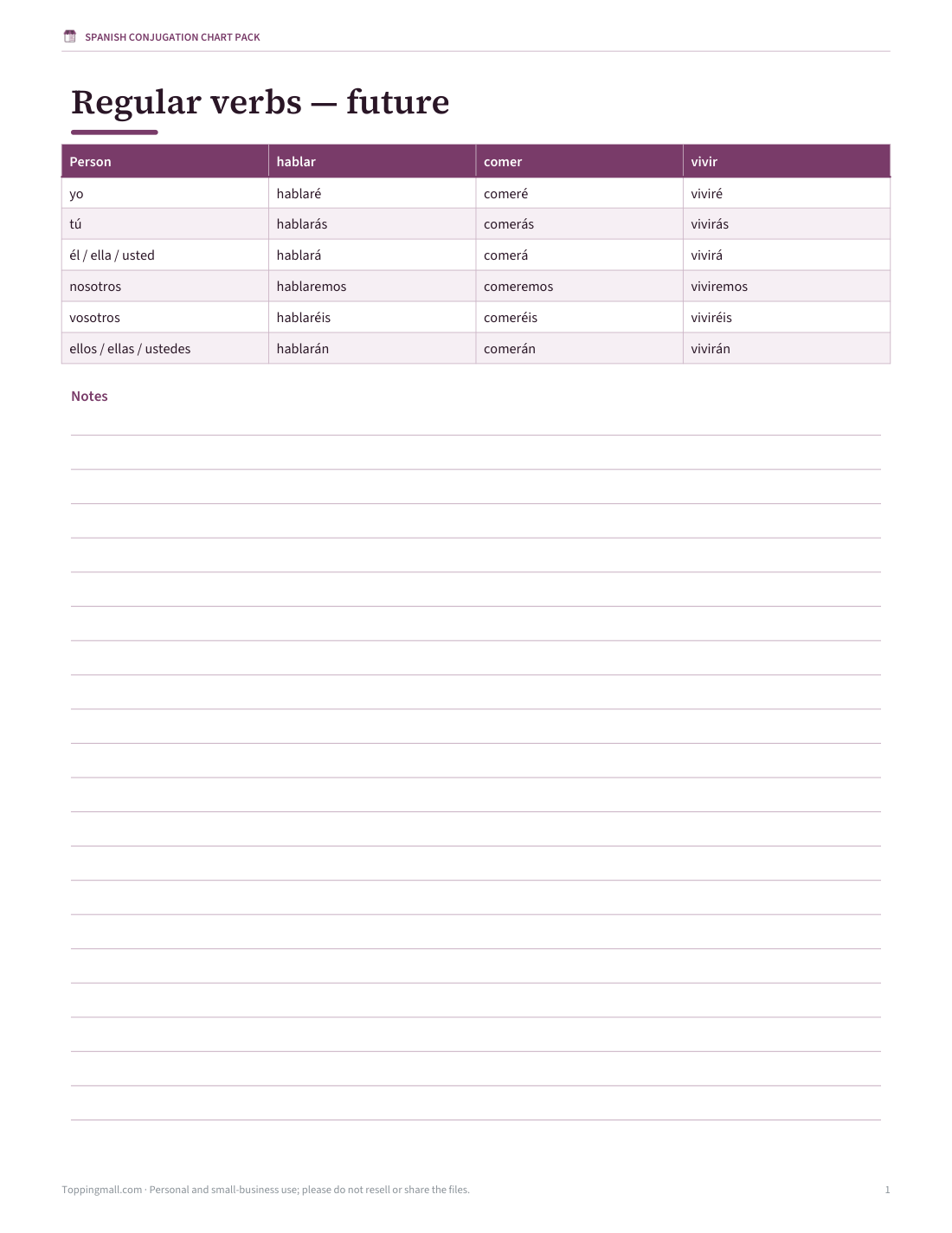
Regular endings in six tenses
| Tense | -ar (hablar) | -er (comer) | -ir (vivir) |
|---|---|---|---|
| Present | hablo, hablas, habla, hablamos, habláis, hablan | como, comes, come, comemos, coméis, comen | vivo, vives, vive, vivimos, vivís, viven |
| Preterite | hablé, hablaste, habló, hablamos, hablasteis, hablaron | comí, comiste, comió, comimos, comisteis, comieron | viví, viviste, vivió, vivimos, vivisteis, vivieron |
| Imperfect | hablaba, hablabas, hablaba, hablábamos, hablabais, hablaban | comía, comías, comía, comíamos, comíais, comían | vivía, vivías, vivía, vivíamos, vivíais, vivían |
| Future | hablaré, hablarás, hablará, hablaremos, hablaréis, hablarán | comeré, comerás, comerá, comeremos, comeréis, comerán | viviré, vivirás, vivirá, viviremos, viviréis, vivirán |
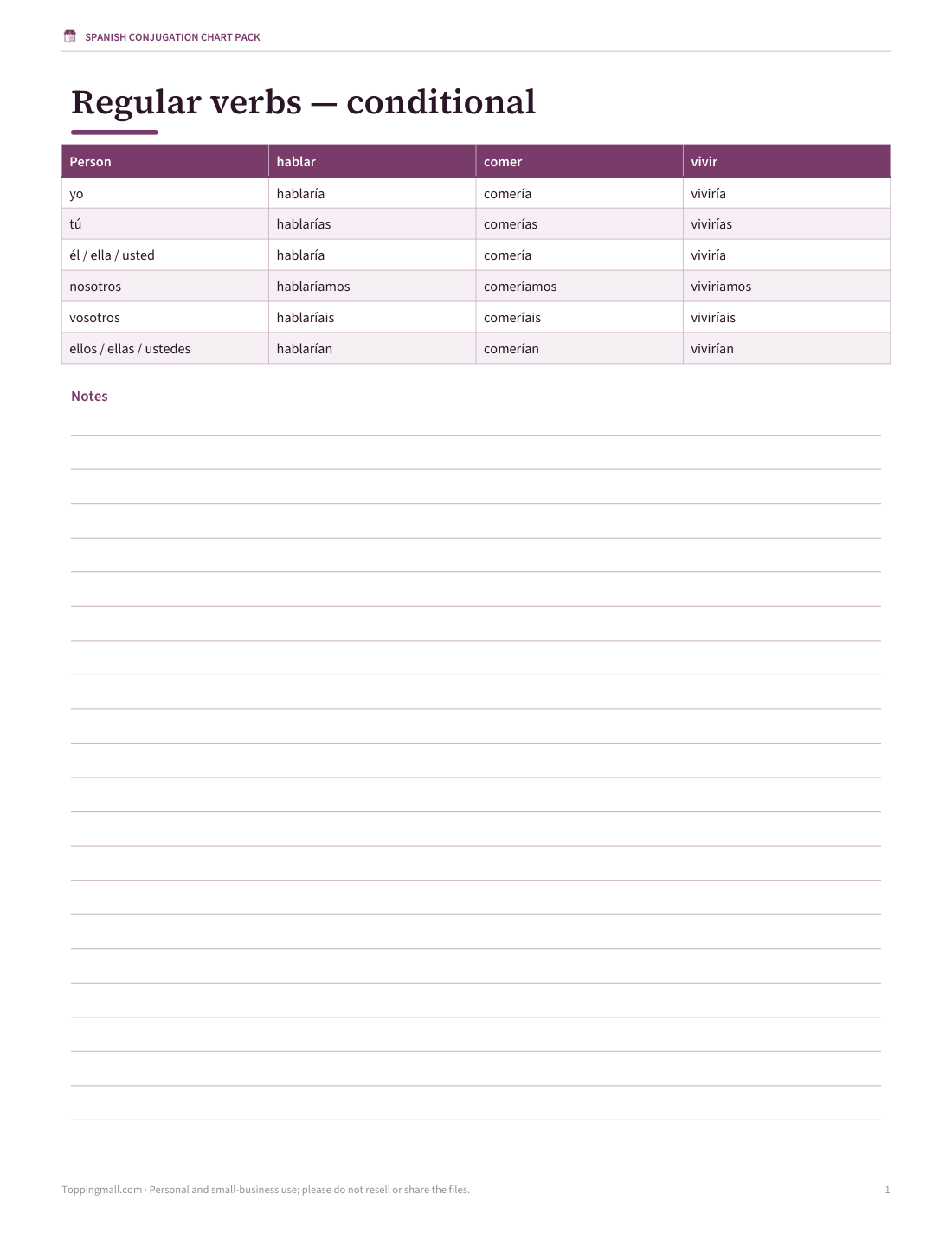
| Conditional | hablaría, hablarías, hablaría, hablaríamos, hablaríais, hablarían | comería, comerías, comería, comeríamos, comeríais, comerían | viviría, vivirías, viviría, viviríamos, viviríais, vivirían |
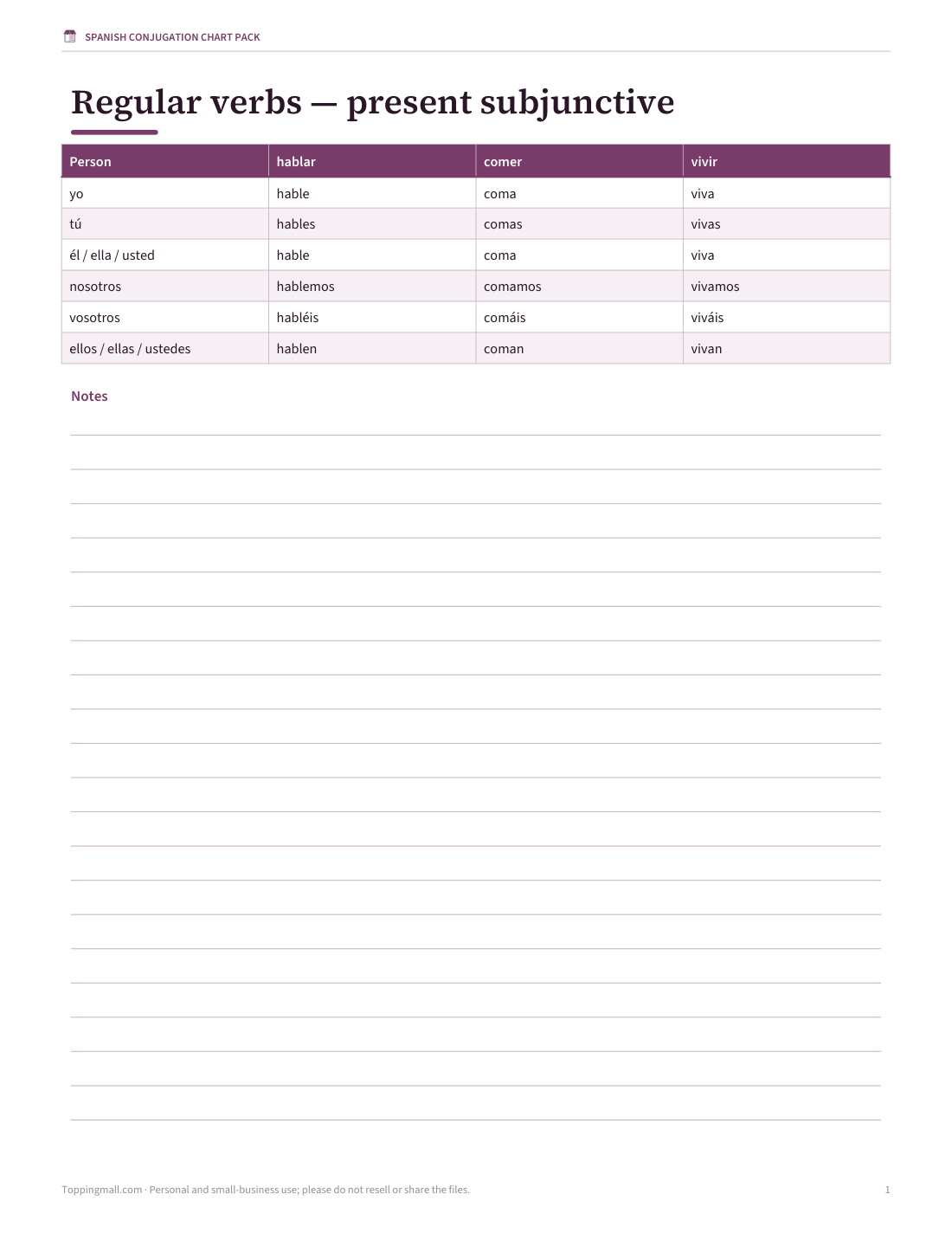
| Present subjunctive | hable, hables, hable, hablemos, habléis, hablen | coma, comas, coma, comamos, comáis, coman | viva, vivas, viva, vivamos, viváis, vivan |
The future and conditional add their endings to the whole infinitive (hablar + é = hablaré), and the endings are the same for all three verb groups.
Ten essential irregular verbs
| Verb | Present | Preterite |
|---|---|---|
| ser (to be) | soy, eres, es, somos, sois, son | fui, fuiste, fue, fuimos, fuisteis, fueron |
| estar (to be) | estoy, estás, está, estamos, estáis, están | estuve, estuviste, estuvo, estuvimos, estuvisteis, estuvieron |
| ir (to go) | voy, vas, va, vamos, vais, van | fui, fuiste, fue, fuimos, fuisteis, fueron |
| tener (to have) | tengo, tienes, tiene, tenemos, tenéis, tienen | tuve, tuviste, tuvo, tuvimos, tuvisteis, tuvieron |
| hacer (to do, make) | hago, haces, hace, hacemos, hacéis, hacen | hice, hiciste, hizo, hicimos, hicisteis, hicieron |
| poder (to be able) | puedo, puedes, puede, podemos, podéis, pueden | pude, pudiste, pudo, pudimos, pudisteis, pudieron |
| decir (to say) | digo, dices, dice, decimos, decís, dicen | dije, dijiste, dijo, dijimos, dijisteis, dijeron |
| querer (to want) | quiero, quieres, quiere, queremos, queréis, quieren | quise, quisiste, quiso, quisimos, quisisteis, quisieron |
| saber (to know) | sé, sabes, sabe, sabemos, sabéis, saben | supe, supiste, supo, supimos, supisteis, supieron |
| venir (to come) | vengo, vienes, viene, venimos, venís, vienen | vine, viniste, vino, vinimos, vinisteis, vinieron |
Notice that ser and ir share the same preterite forms — context tells you whether “fui” means “I was” or “I went”. Many irregular preterites (estuve, tuve, pude, quise, supe, vine) share a set of unaccented endings: -e, -iste, -o, -imos, -isteis, -ieron.
How to learn conjugations
- Learn the regular present-tense endings first; they unlock hundreds of verbs.
- Add ser, estar, ir and tener early — they appear in almost every conversation.
- Say the forms aloud as a chant: hablo, hablas, habla…
- Fill in a blank chart from memory, then check against the answer chart.
- Learn one new tense at a time and use it in short sentences about your own life.
- Revisit old tenses weekly so they stay fresh.
When to use each tense
| Tense | Use it for | Example |
|---|---|---|
| Present | Now, habits, general truths | Vivo en Madrid. |
| Preterite | Completed actions in the past | Comí paella ayer. |
| Imperfect | Ongoing or repeated past actions, descriptions | De niño, hablaba mucho. |
| Future | What will happen | Mañana viviré en otro piso. |
| Conditional | What would happen; polite requests | ¿Podría ayudarme? |
| Present subjunctive | Wishes, doubts, emotions after que | Quiero que hables conmigo. |
What’s in the pack
- Regular -ar, -er, -ir charts for six tenses (PDF).
- Irregular verb charts: ser, estar, ir, tener, hacer, poder, decir, querer, saber, venir (PDF).
- Blank conjugation practice charts with answer keys (PDF/DOCX).
- Stem-changing verb reference (e → ie, o → ue, e → i).
- Excel verb drill that checks your answers.
Formats and printing
Charts print on US Letter or A4 and work well laminated for a desk or binder. The Word versions let teachers change the verbs on practice sheets; the Excel drill works in Excel, Google Sheets and LibreOffice.
AI-assisted content
Charts were compiled with AI assistance and checked before publishing against standard Spanish grammar references. Forms follow peninsular Spanish including vosotros; in Latin America, ustedes is used for both formal and informal plural “you”.
Frequently asked questions
What tenses are in the Spanish conjugation chart?
Present, preterite, imperfect, future, conditional and present subjunctive for regular verbs, plus present and preterite for ten irregular verbs.
Does it include vosotros?
Yes; Latin American Spanish uses ustedes instead, which takes the ellos/ellas form.
Which irregular verbs are included?
Ser, estar, ir, tener, hacer, poder, decir, querer, saber and venir.
Are there practice sheets?
Yes, blank charts with answer keys and an Excel drill.
Can I edit the practice sheets?
Yes, Word versions are included.
Is this a subscription?
No, it is a one-time download.
May I print and share these worksheets with my class?
License: personal and classroom use. Teachers may print and photocopy these files for the students in their own classes, and share them in a password-protected class space (e.g. Google Classroom). Please do not resell, redistribute, or post the files on public websites. One purchase covers one teacher.